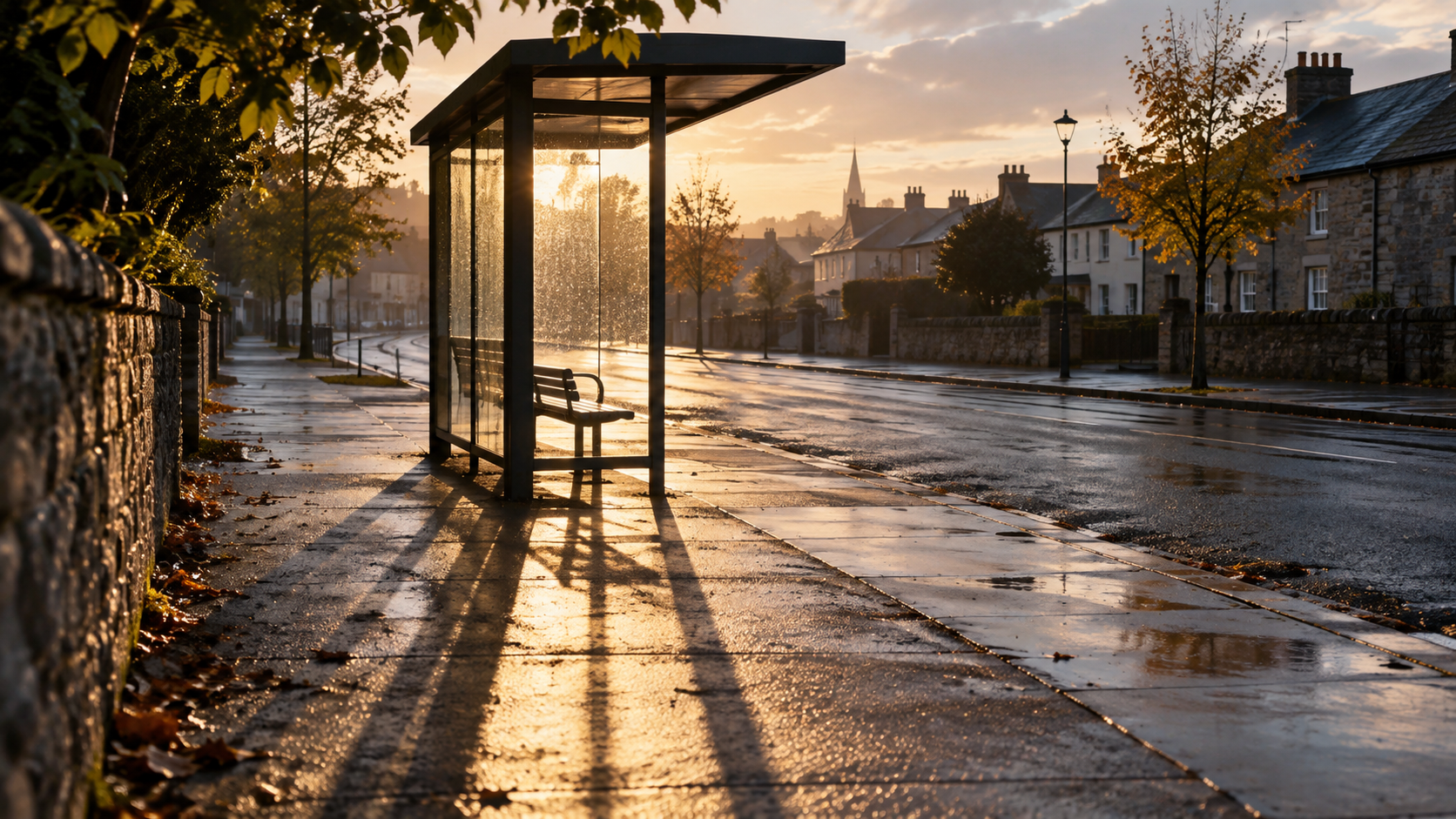
A bus-stop shadow lay across the pavement in five distinct bands. I noticed the bands because I had stopped to answer a message. The photograph began at precisely the moment I stopped looking for a photograph.
There was no extraordinary event. A shelter, a low sun, a patch of damp ground and the edge of a wall supplied everything. By lunchtime the arrangement would be gone. By tomorrow it would probably return in a slightly different form, depending on the weather and the angle of the light.
I walk this street often. Familiarity had made it convenient to stop seeing it.
The first frame was a record of recognition: there is something here. It was not a particularly good picture. The edge of the shelter competed with the shadow, and a bright corner pulled my attention toward a place I did not want the image to lead. I looked again instead of blaming the street for failing to become more dramatic.
I changed my position while keeping safely out of the route people were using. The shelter disappeared from the frame, leaving its evidence on the ground. The picture became quieter. A surface that had seemed uninteresting began holding the structure of the image.
That small adjustment clarified the question. Was I photographing a bus stop, or the way the bus stop divided the light? Both were available. They asked for different decisions.
When I returned home, I selected a few frames and placed them next to one another. The differences were modest but visible. More wall, less pavement. A longer diagonal. A reflection that helped in one image and interrupted another. The sequence recorded my attention becoming more specific.
It also gave me a useful answer to the feeling that photography requires going somewhere better. Sometimes a change of place helps. Sometimes I am asking a new location to do the looking for me. An ordinary street contains details I have not yet taken the time to notice.
I do not mean every bus stop conceals a masterpiece. That claim would burden the next walk with a particularly exhausting expectation. I mean an unremarkable place can offer a clear visual question, and answering that question is a worthwhile way to spend a few minutes.
Working nearby has another advantage: I can return. I can see the same surface after rain, under flat light or when the shelter's shadow has shifted. A single impressive visit can become a trophy. Repeated visits become a conversation.
There are limits to what I want to photograph. I keep other people's use of the street in mind and avoid treating a shared space as my private set. The frame can wait while someone passes. A small picture is not a reason to make an ordinary journey awkward for a stranger.
The final print is modest in size. It sits beside my desk, five bands of dark crossing a pale surface. Visitors rarely identify the bus stop. They notice the pattern, which is what I had eventually decided to photograph.
I still pass the shelter before lunch. Occasionally the light is excellent and I am carrying groceries rather than a camera. I look anyway. A moment does not become wasted because I failed to turn it into a file.
A thought worth keeping?