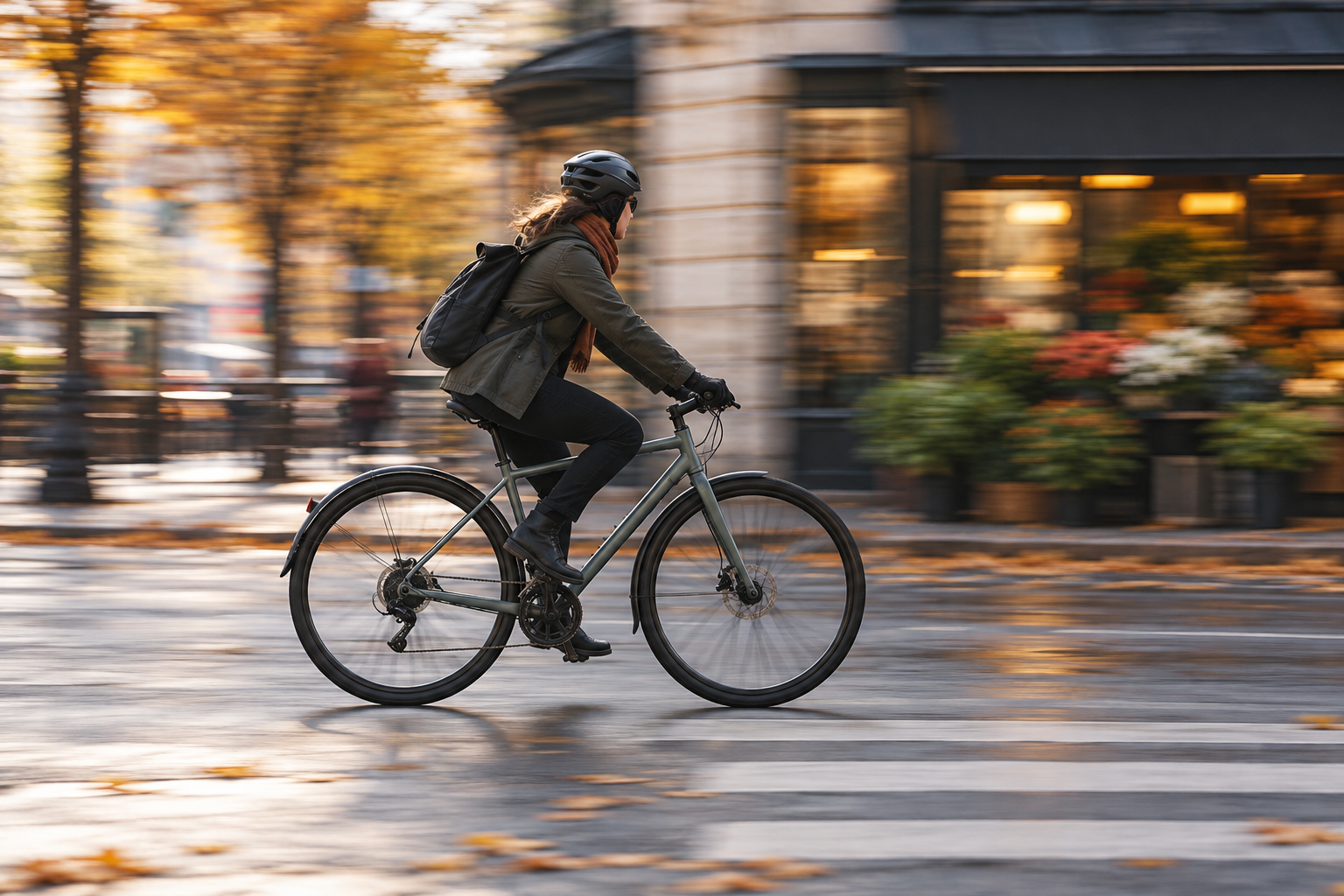
Imagine a cyclist crossing a stretch of sunlit pavement. In one photograph the rider and the spokes are crisp, and the buildings stay still behind them. In another the rider is readable but the windows run sideways into bands of color. Both can describe the same crossing accurately. The decision is which movement the picture should make visible.
A camera records light for a duration, even when that duration is very short. During it, an edge that changes position in the frame can mark more than one place. The mark becomes blur when those positions spread far enough to see. Shortening the exposure gives the edge less time to travel; lengthening it gives the movement room to appear. Nikon's guide to freezing and showing motion illustrates both results, including a stationary background behind a blurred subject and the reversed effect of a pan. Neither result is an accident if it serves the picture.
Choose what needs to stay legible
“Fast subject” is too vague to settle a shutter speed. A cyclist traveling across the frame changes position quickly in the image. The same cyclist approaching along the lens's axis may change size and focus distance while moving less from side to side. A close rider fills more of the frame than a distant one, so a small physical movement can occupy many more pixels. The wheels and feet also move differently from the rider's torso. Nikon's account of photographer Dave Black's panning work makes those differences concrete in photographs: water traveling toward the camera can appear sharp beside a surfer tracked across the frame, and fast and slow exposures give the same kind of action different shapes.
That is why a published fraction of a second is evidence about one photograph, not a setting to copy blindly. Start with the part of the subject that must be legible: a face, the shape of a hand, the lettering on a moving vehicle, or perhaps only the rider's outline. Take a frame and inspect that part at useful enlargement. If it smears in the direction of travel, shorten the time or follow its motion more closely. If it is crisp but the picture feels lifeless, a longer exposure may let the wheels, a sleeve or the background say that something is moving. Nikon's motion guide treats shutter values as starting points relative to the action, then asks the photographer to judge the visible result.
Check focus before blaming exposure time. A subject that has moved outside the focused plane may be soft without leaving a directional trail; a correctly focused subject can still draw a trail during the exposure. The two faults can coexist, particularly when the rider approaches the camera. Nikon's School of Photography working notes explicitly distinguish motion blur from an out-of-focus image. Changing shutter speed cannot repair a focusing system aimed at the wall behind the rider.
A shorter exposure has a light cost
Suppose the setting changes from 1/250 to 1/500 second while the light and aperture stay fixed. The sensor receives light for half as long. That may tame blur, but the photograph now needs either more light through a wider aperture, a higher ISO setting to render the reduced capture brighter, or acceptance of a darker result. ISO does not make the street brighter or send more photons through the lens. It changes how the captured signal is used; if the shorter exposure collects too little light, its noise may be more visible. Nikon's explanation of ISO gives the 1/250-to-1/500 comparison; Adobe's account of high ISO distinguishes signal amplification from collecting more light and describes the noise tradeoff. The D850 exposure-mode manual shows how shutter-priority mode chooses an aperture after the photographer chooses the time.
Opening the lens is not free either. A wider aperture narrows the range of distances that appear acceptably sharp. If the cyclist's face, handlebars and background must all read clearly, that may matter more than a little movement in the spokes. A camera in shutter priority can run out of available aperture; Auto ISO can then climb toward its chosen ceiling. The D850 Auto ISO instructions even warn that its minimum shutter speed can be exceeded when the ISO limit prevents the intended exposure. Automatic controls make a trade on the photographer's behalf, but they cannot repeal the available light.
The practical question in dim light is therefore which loss the picture can afford. A grainier but legible expression may carry the moment. A clean frame with a blurred hand may do so too, if the hand's movement is the point. A dark, crisp frame that has to be lifted aggressively later may keep less useful information than a slightly slower exposure. There is no single shutter number that decides among these outcomes for every subject, lens and scene.
Move with the subject
Panning changes the movement that the camera sees. Turn smoothly with the cyclist before pressing the shutter, keep following through while it is open, and let the buildings slide across the frame. The rider's torso can remain in nearly the same place in the image while the background travels. The wheel spokes may still blur because they rotate relative to the bicycle, and the rider may bob even if the pan follows the overall path. Dave Black's account of his panning method stresses beginning the movement before release and continuing afterward; Nikon's motion guide also notes that many attempts may miss the balance.
The useful exposure is long enough for the background to move visibly, yet short enough that the feature you want to hold does not wander too far from its path. This balance changes with subject speed, distance, framing and how evenly you turn. It is often easier to judge from a small series of frames than from a formula. Look at the rider, then the background. If both are smeared, the pan may have lagged or jerked. If both are frozen, the exposure may have been too brief to show the movement you wanted.
Image stabilization can help with hand movement, but its name can invite a wrong expectation. It compensates for movement of the camera or lens; it does not stop an independent cyclist. Some systems recognize a deliberate pan and suppress shake across it. In the Nikon Z50II vibration-reduction manual, for example, a horizontal pan leaves the intended horizontal camera movement alone while reducing vertical shake. That is a useful distinction when the rider's face is sharp vertically but the street carries a horizontal streak. It is specific to compatible Nikon lens and mode combinations, not a promise that any stabilized camera can rescue any long exposure.
When the light itself is brief
A flash adds another clock. If its pulse supplies most of the light on a moving subject, the pulse's duration can determine how far that subject records during the bright part of the exposure. The duration is not a fixed magic number: Profoto's published A2 specifications give a much longer measured pulse at full output than at low output. A photographer trying to freeze a splash or a hand should care about the light's duration and the ambient light that continues to register while the shutter remains open. A bright room can leave a ghost around an otherwise flash-sharp subject.
Synchronization matters as well. A conventional flash must fire while the relevant sensor area is exposed; a camera's flash-sync setting and flash compatibility set the available choices. The D850 flash-sync manual documents a sync limit and an Auto FP high-speed mode for compatible units. It would be a mistake to assume that selecting a very short shutter time always gives the same single-pulse flash photograph. At the other end, Nikon's flash-mode manual describes slow sync, which leaves time for the background to register, and rear-curtain sync, which fires just before closing so a moving light trail can appear behind the subject. Those are deliberate ways to divide the picture between a moment and its path.
Return to the cyclist and decide what the viewer should understand first. If it is an expression, make that expression survive the exposure and focus on it. If it is passage through the street, leave enough duration for the street to move. If it is both, follow the rider and let the windows streak. The shutter, aperture, ISO, stabilization and flash each answer a different part of the problem. The photograph becomes coherent when their choices serve the same visible idea.

A thought worth keeping?