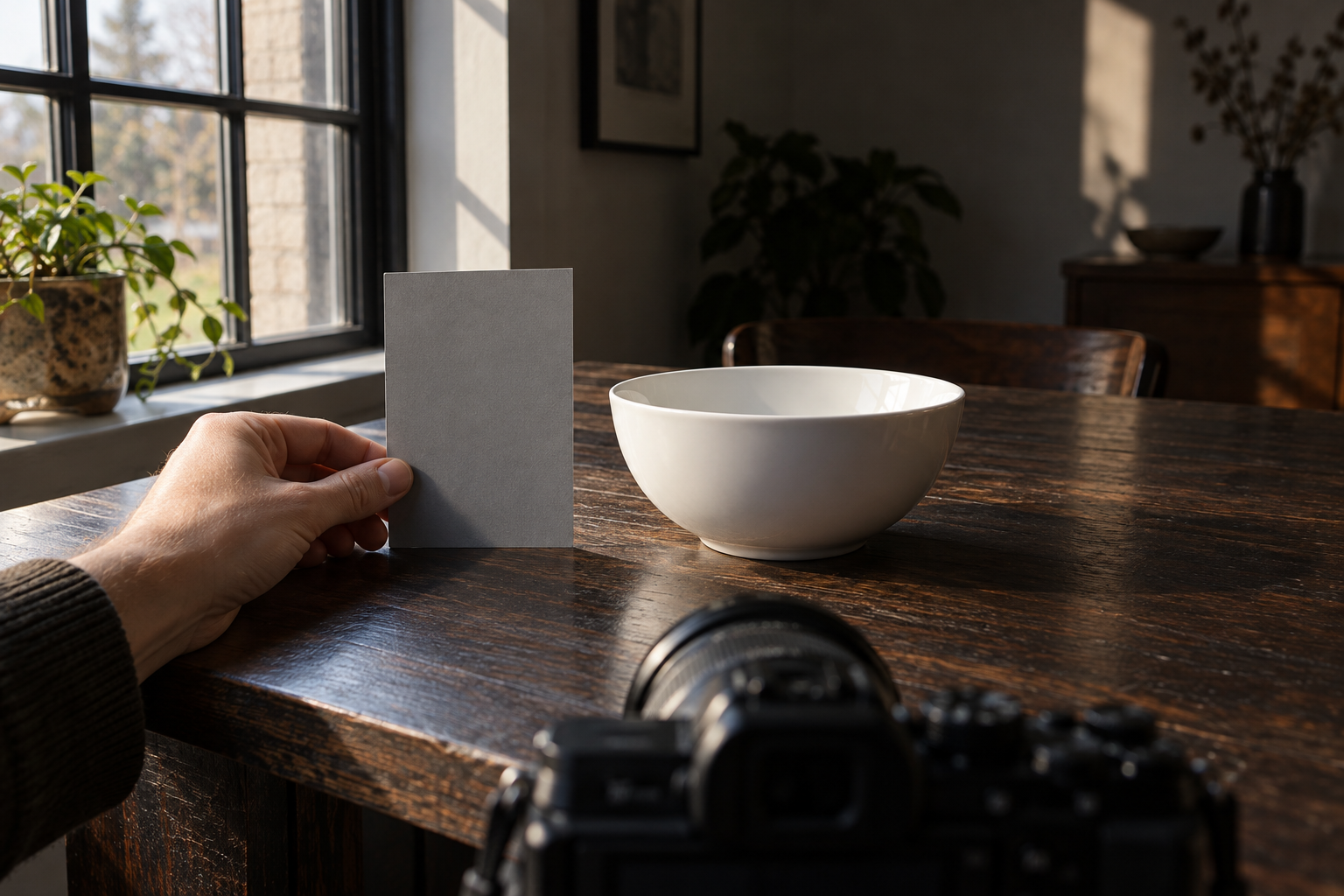
Put a white bowl on a dark table beside a window and the camera has a small problem before anyone presses the shutter. The bowl sends much more light toward the lens than the table does. A reflected-light meter can measure what comes back from each, but it cannot learn from that measurement alone which surface was meant to look white, which was meant to look dark, or how much of the window should retain detail. Move the frame a few inches so that the table occupies more of it, and an automatic exposure may change even though the light falling on the bowl has not.
A grey card gives the meter a surface whose reflectance is known. It changes the question put to the camera. Instead of asking the camera to infer illumination from a scene full of different materials, the photographer briefly asks it to read one deliberately ordinary surface in the subject's light. Kodak's instructions for its R-27 card specify that the grey side reflects 18 percent of the light falling on it. That percentage describes the card's surface. It does not mean that the card should occupy 18 percent of a digital file's brightness scale, or that every camera meter is set to one identical 18-percent target.
A reference in the same light
The useful step is placing the card where the subject is lit. If the bowl is by the window, a card held near the camera under a ceiling lamp describes a different illumination. If it is held in the bowl's shadow, its reading will invite more exposure than the bowl's lit side needs. Kodak advises putting the card in the subject's light, reading it from the camera's position or direction, and keeping glare, shadows and colored reflections off its face. The card must fill the area the meter is reading; with a spot meter that is straightforward to judge, while a small card surrounded by dark furniture in a broad metering area will give a mixed reading. Kodak's placement and metering guide makes each of these conditions part of the measurement rather than a nicety after it.
Set the exposure from that reading, then remove the card without allowing the camera to meter the changed scene again. Manual exposure or an appropriate exposure-lock function can do this, depending on the camera. If the light changes, the reference needs taking again. A cloud crossing the window, a subject moving from sun into shade, or a lamp being switched on changes the thing the card was there to measure. The procedure gives a consistent starting exposure; it is not an instruction to preserve one shutter speed all afternoon.
Consider what happens if the meter reads only a white wall. A simple reflected reading treats the large amount of returning light as evidence that the scene is brightly illuminated and may recommend less exposure, rendering the wall duller than intended. A black jacket can push a reading the other way. The grey card removes much of that ambiguity by offering the meter a known surface. It does not oblige the photographer to render every scene at the same final brightness. Even Kodak's card instructions discuss small exposure adjustments for very light or dark subjects and recommend bracketing when the best exposure is uncertain. The card supplies a point of departure; the photograph still needs a decision about the subject.
That distinction matters more with a modern camera than the familiar phrase “meters see everything as 18-percent grey” suggests. A spot reading, a center-weighted reading and a camera's scene-evaluating mode can use very different parts of a frame. Nikon's D850 manual, for one documented camera, describes matrix metering that considers tone distribution, color, composition and sometimes lens distance, as well as separate spot and highlight-weighted modes. An ISO standard for general-purpose photoelectric exposure meters likewise distinguishes calibration of reflected-light and incident-light meters; it is not a declaration that every camera's automatic exposure algorithm must give an 18-percent card an exact output value. The card is a measured reference, not a magical switch that makes unlike cameras behave alike.
Reflected light and light that arrives
There is another way to ask about the illumination. An incident-light meter is placed at the subject and measures the light arriving there, normally with its own diffuser, rather than measuring light bounced off the subject's surface. A reflected-light meter looks toward the subject; a grey card lets that kind of meter take a reading from a surface of known reflectance. ISO's meter specification covers these as distinct kinds of measurement, while Kodak describes its grey-card reading as reflected light from the illumination that falls on the card.
An incident meter can be especially helpful when a scene contains large white and black areas, because those surface colors do not enter its reading in the same way. But it has to reach the relevant light. If the subject is high on a stage or partly lit by a narrow shaft of sun, a reading made where the photographer stands may be of little use. A grey card photographed at the subject during setup can provide a reference to inspect later from the camera position. If neither meter nor card ever reaches that light, neither can give a valid substitute reading. And neither method knows what the photographer wants to emphasize in a backlit portrait or a silhouette. Both measure light under a set of conditions; neither makes the aesthetic choice.
One card, two jobs
The same neutral target can also answer a different question: what color is the light? Exposure decides how much light reaches the recorded image. White balance adjusts the relative rendering of colors so that a neutral surface appears neutral under that light. They can be checked with the same card, but one setting does not stand in for the other. Canon's camera manual describes taking a custom white-balance reading from white paper, cloth or a photo-quality grey card; it warns that a target rendered completely black or white may give a poor reading. For that job, the target must be under the light that will illuminate the subject when the photograph is taken.
The word grey is not enough. A material can look neutral to the eye in one room yet reflect red, green and blue wavelengths unevenly under another lamp. In Better Light's measured study of grey-card materials, Robin D. Myers treats a flat spectral response, a matte surface and freedom from fluorescent optical brighteners as important properties of a color reference. His tested samples show why a scrap of grey packaging is a risky substitute for a neutral photographic target. That is a statement about color balance, not a claim that every grey-looking scrap is unusable for a rough exposure reading. The two jobs demand different knowledge of the surface.
Mixed light adds a harder limit. A card in cool window light can help neutralize the bowl in that light, but it cannot simultaneously make a tungsten-lit corner neutral if the two sources color different parts of the scene. Nor is neutral always the desired look: removing the gold from a late sunlit wall may erase exactly what made the light worth photographing. A card in a reference frame gives a defensible baseline from which to keep or change that warmth deliberately.
The tones the card cannot save
Return to the window. The grey-card exposure may put the bowl where its surface retains texture while the outside view becomes featureless white, or it may keep the window and leave the table nearly black. The card has located a reference within the scene's tonal span; it has not reduced the span. If the gap between the brightest and darkest important areas exceeds what the camera and chosen output can hold, no middle reference can preserve detail at both ends. The possible remedies change the problem: alter the light, choose a different exposure and priority, make several exposures where the subject allows it, or accept a bright window or deep shadow as part of the picture. Adobe's Camera Raw guide defines clipping as values beyond the image's representable range and recommends inspecting highlight and shadow clipping while adjusting tones.
File format changes how much room remains for a later color decision. In a raw workflow, the camera's white-balance choice can be read as an initial setting and adjusted in the converter; Adobe explains that a JPEG or TIFF has already had that choice applied to its pixel values, so a later temperature adjustment is an approximation. Raw is useful room for editing, not a promise that a fully clipped highlight contains recoverable detail. A neutral card in the first frame can guide a sequence of raw edits and help a JPEG photographer set balance before capture, but neither use enlarges the sensor's range.
The most revealing result of using a grey card may be the moment after the reading, when the card leaves the frame. The light is the same; the photograph may be different. The meter has been given a stable fact about one surface, and the photographer can now decide how the white bowl, dark table and bright window should relate to it. That is a more useful freedom than a claim of automatic correctness.

A thought worth keeping?